By: [Your Name] | Category: Winter Camping Gear | Estimated Read Time: 12 Minutes
Introduction: The Promise of Dry Heat in a Frozen World
Let’s set the scene. It’s 11:00 PM in a snow-covered pine forest. The temperature has plummeted to -15°F (-26°C). You are zipped inside a canvas hot tent, but unlike the old days of fiddling with damp firewood and smoky kindling, you are listening to a gentle, rhythmic whirring sound. It’s the sound of a small auger feeding wood pellets into a glowing burn pot. You are not shivering. You are not worried about the fire going out while you sleep. You are simply… comfortable.
This is the reality for a growing number of winter campers who have made the switch from traditional wood-burning stoves to pellet-burning units. Among the top contenders in this niche market, the Green Stove Hori 5 has emerged as a polarizing yet highly praised piece of equipment. But is it worth the hype and the price tag? As someone who has spent the last two winters testing this unit in everything from mild 20°F nights to brutal sub-zero blasts inside a Nature Hike Dune 10.9 and an Eskimo Ice Hub, I am here to give you the unvarnished truth.
This review isn’t just a spec sheet dump. It is a user experience deep-dive—focusing on what it feels like to live with the Hori 5, the good, the bad, and the sooty. If you are looking for a way to extend your camping season and stop waking up to frost on your sleeping bag, read on.
Unboxing and First Impressions: Small but Mighty
The first thing I noticed when the Hori 5 arrived was the shipping weight. This is not a backpacking stove. At roughly 35 lbs (15.8 kg), it is a “glamping” or “basecamp” luxury item. However, once you lift it, you realize the weight is justified by the build quality. The body is constructed from thick, stainless steel, and the top cooking plate is heavy-duty enough to support a cast iron skillet full of bacon and eggs.
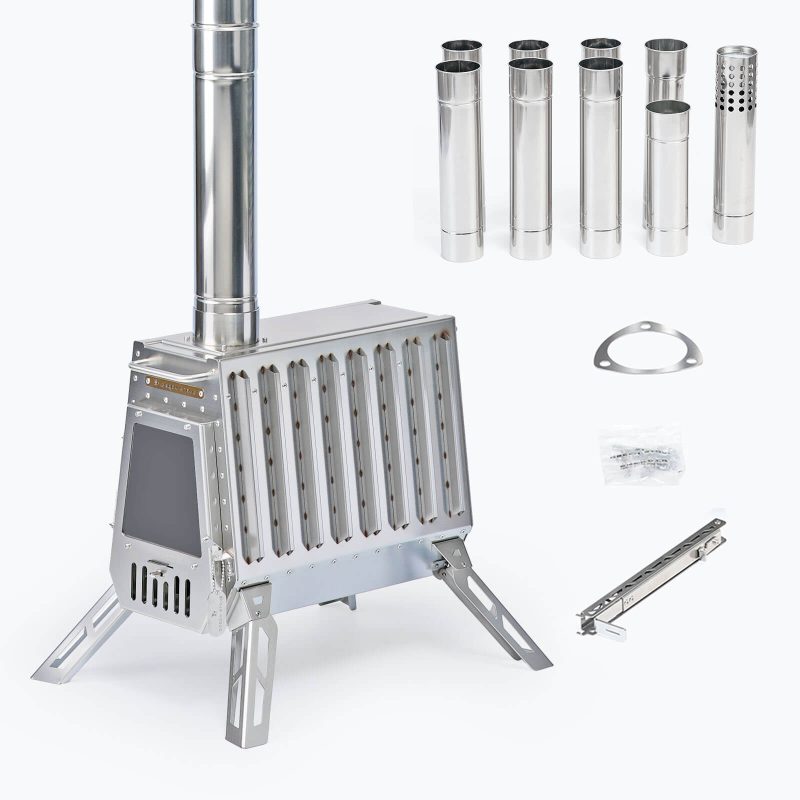
Unlike the collapsible titanium stoves from Pomoly or Winnerwell that require a complex assembly of interlocking parts, the Hori 5 is a single-piece unit (with the exception of the chimney pipe). This is a massive advantage in the field. There are no tiny wingnuts to lose in the snow, no sharp edges to slice your fingers on while assembling in the dark. You literally place it on your tent’s stove jack, connect the double-wall pipe, plug in the power cable, and it is ready to go.
One of the most frequent questions I get is about the noise. The Hori 5 features a small combustion fan and a pellet auger motor. When running, it produces a low hum (about 45-50 decibels). It is not silent, but it’s not loud enough to disrupt conversation. In fact, I find the white noise soothing—it masks the sounds of wind howling outside and creates a “space heater” vibe inside the tent.
Feature Analysis: The Nuts and Bolts of Comfort
To understand the Hori 5, you have to understand that it is a hybrid. It is not a traditional log-burning stove, and it is not a full-sized home pellet stove. It is a compact, digitally-controlled heater designed specifically for small to medium canvas tents (up to 300 sq ft). Let’s break down the key features that define the user experience.
1. The Pellet Hopper: The Gift of Sleep
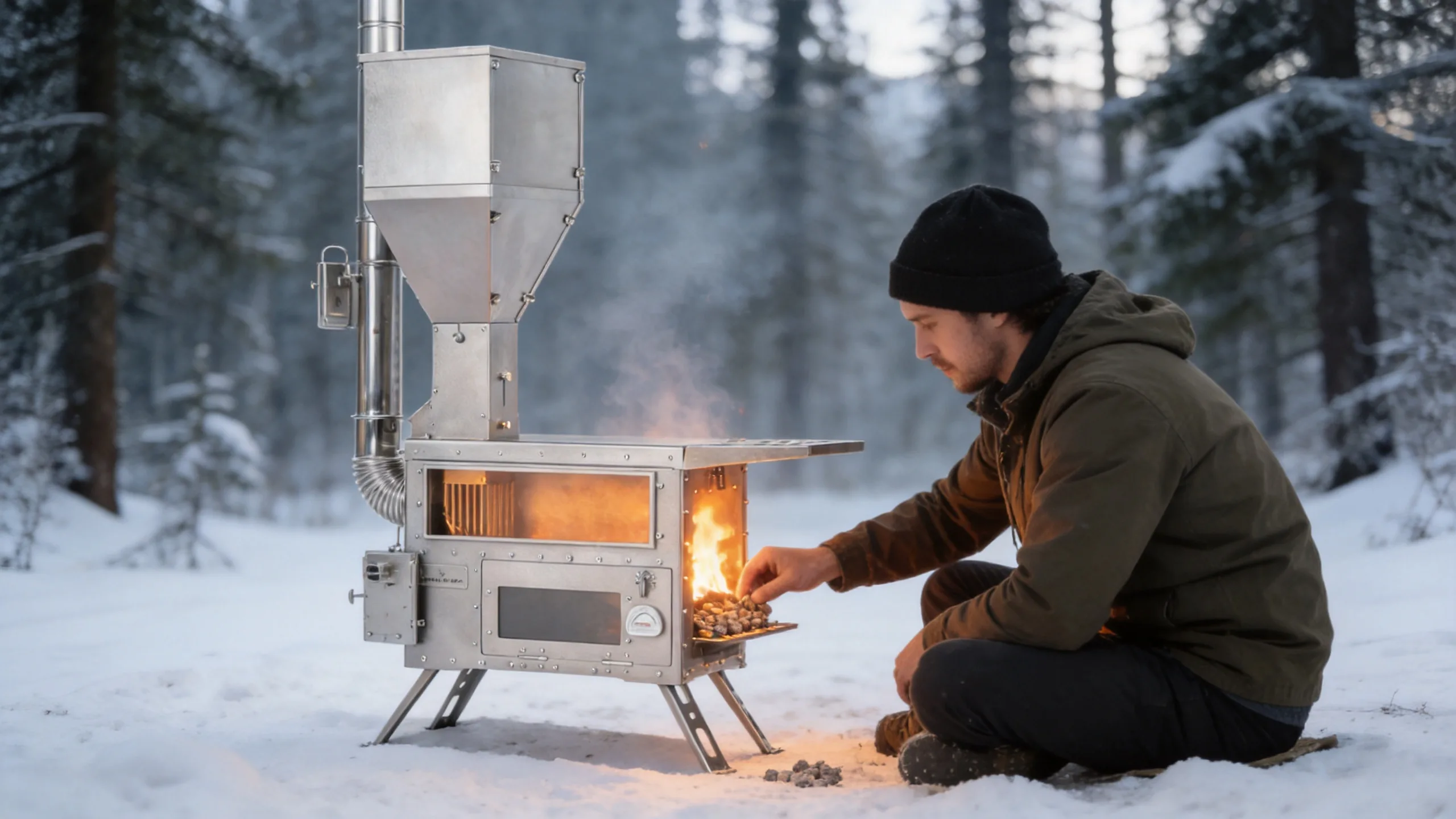
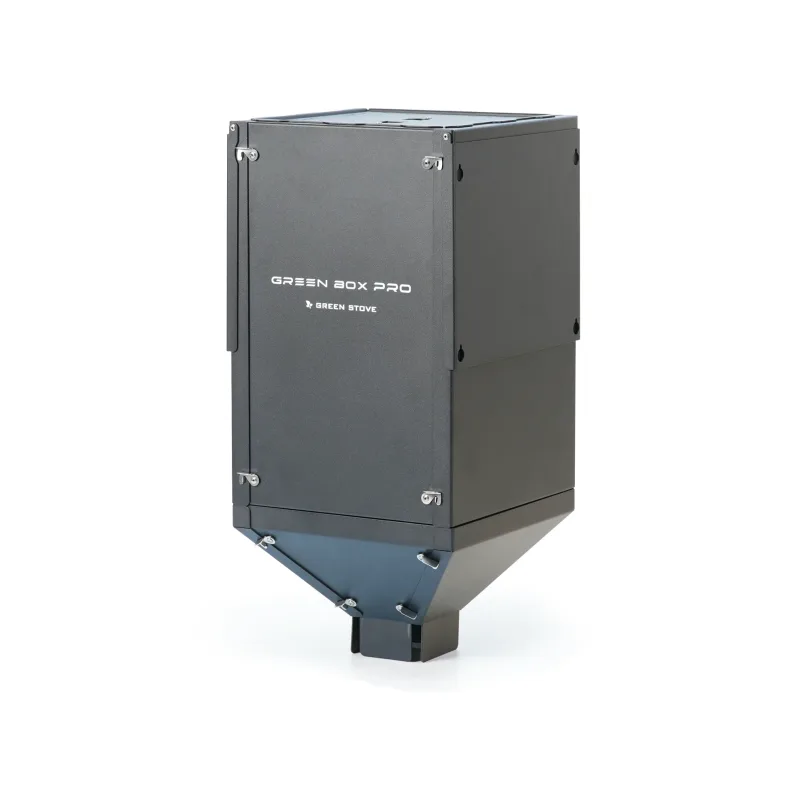
The most touted feature of the Hori 5 is its hopper capacity and burn time. The stock hopper holds about 20 lbs of wood pellets. On the “Low” setting, which is adequate to keep a 10×10 tent at a t-shirt-worthy 60°F, I have consistently achieved 10 to 12 hours of burn time.
User Experience: This is the game-changer. In the old days, with a wood stove, I would have to wake up every 2-3 hours to feed the fire. With the Hori 5, I load the hopper at 10 PM, and when I wake up at 7 AM, there is still a pile of pellets sitting in the hopper, and the burn pot is glowing with embers. It allows for a full night of sleep without the anxiety of the tent temperature dropping to freezing. One Reddit user noted they only got “2 hours max heat” but I suspect they were running it on “High” in a giant tent. When used correctly (low and slow) in a properly insulated tent, the 8-10 hour claim is surprisingly accurate.
2. The Digital Control Panel: Precision Meets Simplicity
Gone are the days of “drafting” the stove by adjusting a damper. The Hori 5 has a digital control panel with three buttons and a dial. You can cycle through 5 power levels (Low to High). The auger speed and fan speed automatically adjust to your setting.
User Experience: The learning curve is almost zero. You press “Power,” wait for the start-up sequence (which includes a 5-minute igniter rod heating up), and then the pellets drop. The most common complaint I saw on forums like r/HotTentCamping was that it “isn’t hot enough.” This is a matter of expectation. A pellet stove produces a steady, dry heat, not the radiant inferno of a metal wood stove. You won’t be able to sit 3 feet away and feel like you’re in a sauna, but the ambient air temperature will be consistently warm. I found the “Medium” setting to be the sweet spot for cooking and lounging, while “Low” is perfect for sleeping.
3. The Cooktop: A Chef’s Paradise
The top of the Hori 5 is a flat, thick steel plate. This is arguably a better cooking surface than most home stoves.
User Experience: I have cooked everything on this stove—from boiling water for coffee in the morning to pan-searing steaks at night. The surface area is large enough for a 10-inch skillet and a small kettle simultaneously. The heat distribution is even, and the temperature is easy to control by adjusting the power level. Unlike a propane stove that burns through canisters in the cold, this stove costs pennies per hour to run. The only downside? When cooking bacon, the grease splatters and burns onto the surface, creating a smell that mixes with the smoke. It’s not unpleasant, but it does require a quick wipe-down in the morning.
4. The “Hot” Top and Safety
This is critical: The top of the stove gets very hot. The sides get hot. The glass door gets hot. The exhaust pipe gets glowing red at high settings. When using this inside a hub-style tent (like the Ice Hub), you absolutely must use the heat shield and stand-off brackets. The Hori 5 does not have a built-in air gap on the sides.
User Experience: It is a fire hazard if you are careless. I burned a hole in a cheap tarp that was resting 4 inches away from the side of the stove. However, with proper clearances (as specified in the manual), it is safe. The digital control panel actually acts as a thermostat in a way—when the internal temp of the stove reaches a certain threshold, the auger stops feeding pellets to prevent overheating, then kicks back on when it cools down. This prevents “runaway” temperatures.
5. The Ash Pan & Maintenance
Every stove produces ash. It is the reality of combustion. The Hori 5 has a pull-out ash drawer located below the burn pot.
User Experience: This is a double-edged sword. The drawer is easy to slide out and dump—no scooping ash out of a deep firebox. I do this every two full hoppers (roughly 24 hours of burn time). However, the burn pot is small. If you use “High” quality pellets (like Lignetics or Hamer’s), the burn is clean and the ash is minimal. If you use cheap hardwood pellets from a hardware store, you will get “clinkers” (hardened mineral deposits) that block the air holes in the pot. This is the #1 cause of the stove going out. Pro Tip: Always run the stove on “High” for 15 minutes before shutting it off to burn off excess creosote and keep the burn pot clear.
The Good, The Bad, and The Ashy: Pros & Cons
No product is perfect. Here is the real breakdown based on my extensive field use, corroborated by user feedback from Reddit communities like r/WinterCamping and r/camping.
✅ The Pros: Why You Should Buy It
- Unrivaled Burn Time: 10+ hours on low is a literal game-changer. It allows for safe, uninterrupted sleep in extreme cold.
- Digital Control: The precise control over temperature is something no wood stove can offer. Set it to 3, and it stays at 3.
- No Refueling Anxiety: With a hopper full of pellets, you can leave the tent for a 3-hour ice fishing session without fear of the fire going out and the tent freezing.
- Dry Heat: Pellet combustion produces very little moisture compared to wood. You won’t get that “dripping condensation” on the tent ceiling as severely as you do with wood.
- No Wood Processing: No splitting logs, no carrying wet wood, no fighting with kindling. Pellets are uniform, dry, and easy to store in a 5-gallon bucket.
- Cooking Surface: The large, flat top is perfect for winter cooking. It turns your tent into a kitchen.
❌ The Cons: The Reality Check
- The Power Dependency: This is the elephant in the room. The Hori 5 requires 12V DC power (or 110V with an adapter). If your battery dies, you have an expensive metal paperweight. You must have a robust power solution (like a Jackery or a dedicated 12V 50Ah lithium battery) to run the fan and auger. On low, it draws about 10-15 watts—a small battery will last 24 hours, but you must bring it.
- Weight and Packability: At 35 lbs, it is heavy. It doesn’t break down. It takes up a large footprint in your vehicle. It is not for backpacking or canoeing to a remote site; it is for car camping or snowmobile/sled access.
- The “Clinker” Issue: Pellet quality matters. If you leave the stove on “Low” for 12 hours with low-quality pellets, the burn pot will clog, the fire will choke, and you will wake up cold. You must clean the pot daily.
- Initial Cost: The Hori 5 is not cheap. Combined with the battery, the connection cables, and the optional hopper extension, you are looking at a significant investment. However, compared to the cost of a tent, sleeping bags, and pads, it’s a small price for comfort.
- Not a “Radiant” Heater: If you are used to sitting right next to a glowing wood stove, you will be disappointed. The Hori 5 radiates a lot of heat from the top and glass, but the sides are relatively cooler due to the air jacket. The heat is more “convection” (warming the air) than “radiant” (warming the object).
Field Test: The “Ice Hub” Scenario
To give you a concrete example, let me detail a trip I took in February with the Hori 5 inside an Eskimo Ice Hub 6. The outside temp was -5°C (23°F) with a 15 mph wind.
I set up the stove, connected the 12V line to a 30Ah lithium battery, and loaded the hopper. I started the stove on “High” to get the tent up to temperature (it took about 45 minutes), then dialed it down to “Low.” Inside the tent, I was wearing a light fleece and sweatpants. The temperature at head height (sitting on a chair) was 68°F. The temperature at the floor was 55°F. There is a heat stratification issue—your feet will be colder than your head—but it is manageable.
![Hori 5 Max Pellet Hot Tent Stove with Oven [Classic Control Version]](https://green-stove.com/wp-content/uploads/2025/10/hori5maxgreenstove002-800x800.webp)
![Hori 5 Max Pellet Hot Tent Stove with Oven [EASY OPERATION VERSION]](https://green-stove.com/wp-content/uploads/2026/09/61b6a5hzqRL._AC_SL1500_-800x800.webp)
![GREEN STOVE Hori 5 All-In-One Gravity Fed Pellet Wood Burning Hot Tent Stove [Classic Control Version]](https://green-stove.com/wp-content/uploads/2025/06/Green-Stove-Hori-5-Pellet-Stove-800x800.webp)