# The Green Stove Hori 5: Is This Pellet-Burning Powerhouse the Ultimate Winter Camping Companion?
## Introduction: My Journey Into the World of Pellet Stoves
I’ll be honest with you – when I first started hot tent camping three winters ago, I was a complete novice. I dragged a massive propane heater into my canvas tent, watched condensation drip from the ceiling like a leaky faucet, and woke up every morning feeling like I’d slept in a sauna that had been set to “tropical storm.” It wasn’t until a fellow camper at a frozen lake in Minnesota showed me their setup – a compact, steel box glowing with an almost hypnotic orange light – that I realized I’d been doing winter camping all wrong.
“That’s a Green Stove Hori 5,” they said, tossing a handful of wood pellets into the hopper like they were feeding a hungry pet. “Best investment I’ve ever made for winter camping.”
Three years and dozens of overnight trips later, I’m here to give you the comprehensive, real-world review of the Green Stove Hori 5 that I wish I’d had before making my purchase. This isn’t a spec sheet recitation – this is the story of how a 27-pound steel box transformed my winter camping experience from “surviving” to “thriving.”
## What Exactly Is the Green Stove Hori 5?
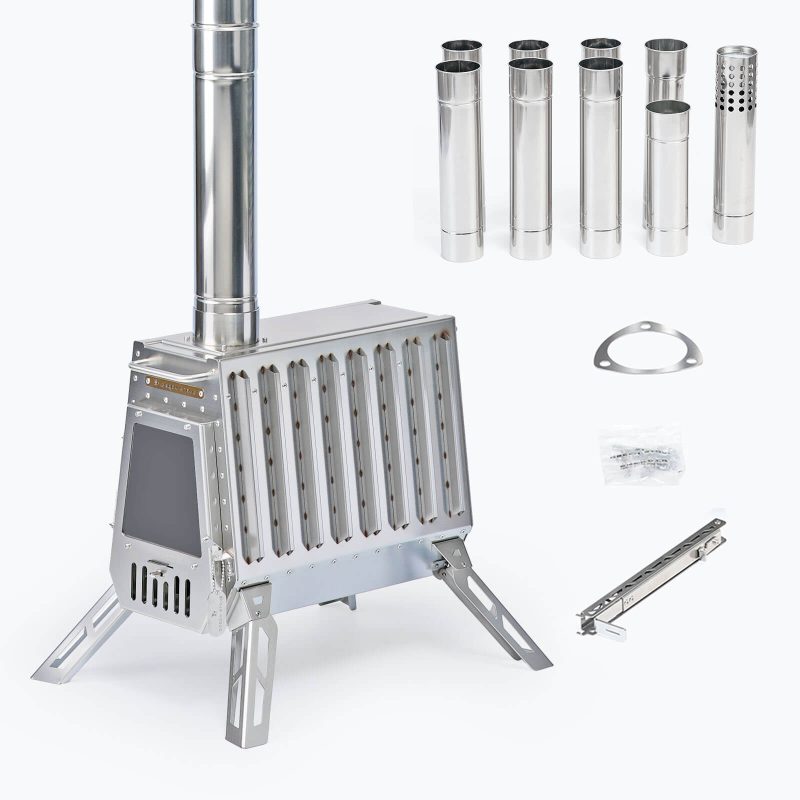
Before we dive into the nitty-gritty, let’s establish what we’re working with. The Green Stove Hori 5 is a compact, multi-fuel camping stove specifically designed for hot tenting, ice fishing shelters, and small expedition tents. It’s constructed from heavy-gauge stainless steel, features a pellet hopper, a large cooktop surface, and a collapsible design that packs down into its own body for transport.
The “5” in the name refers to its size classification – it’s the mid-range option in Green Stove’s lineup, designed to heat spaces up to 200 square feet (which covers the vast majority of hot tents on the market). It runs primarily on wood pellets, though it can also burn small wood chunks and even biomass fuels in a pinch.
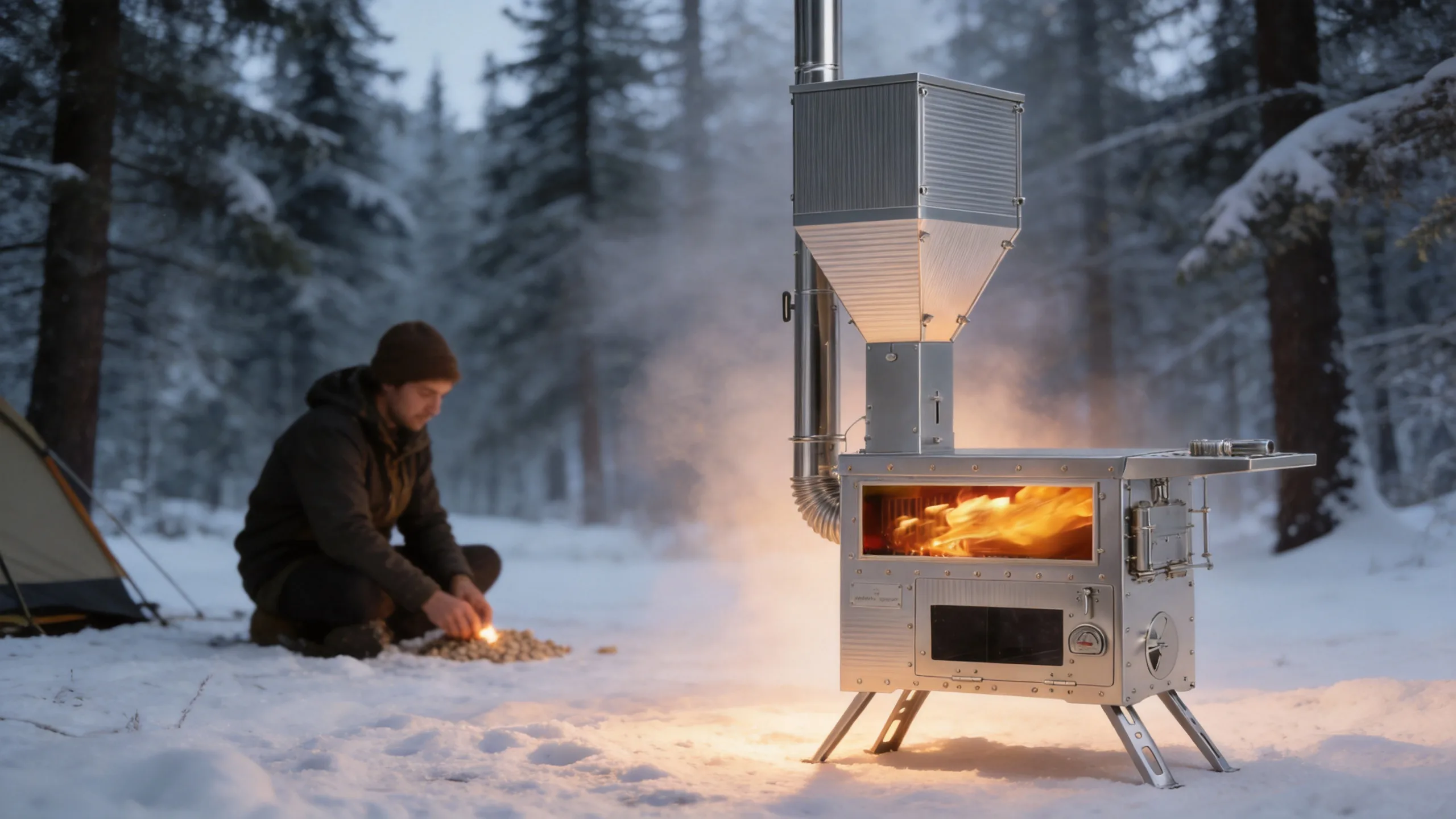
But here’s what really sets it apart from the dozens of other tent stoves on the market: the pellet auto-feed system. Instead of constantly feeding wood into a firebox like a lumberjack on espresso, you load the hopper once, and the stove takes care of the rest through a gravity-fed mechanism. This single feature completely changes the winter camping game.
## Features Analysis: Breaking Down What Makes This Stove Tick
### The Pellet Hopper: Your Ticket to Uninterrupted Sleep
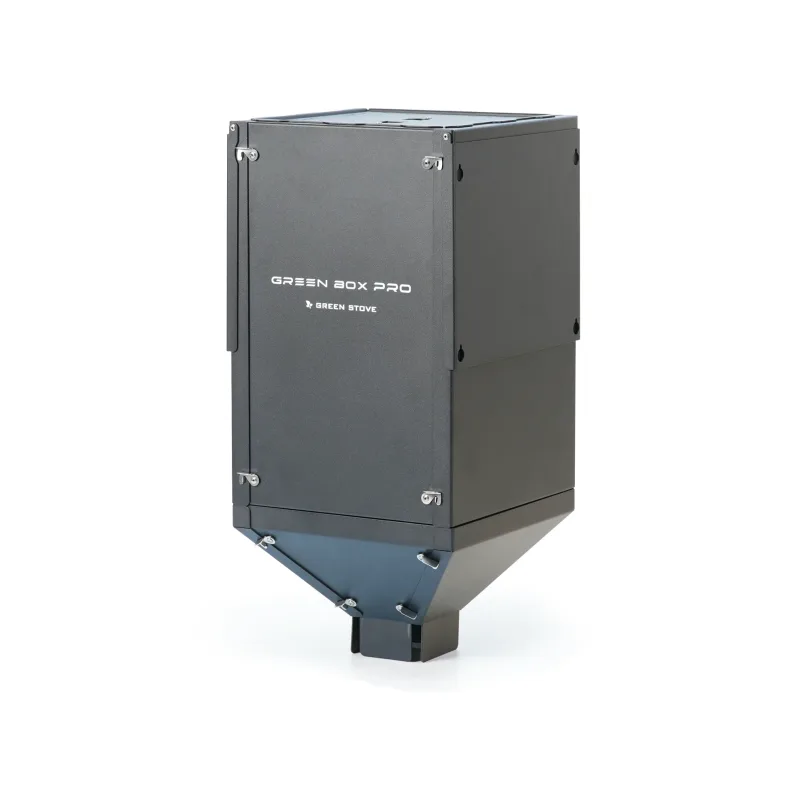
Let’s start with the feature that sold me on this stove – the pellet hopper. With a full bin of pellets (approximately half of a 40-pound bag), the Hori 5 delivers a solid 6 hours of continuous heat. For perspective, that’s a full night of sleep without having to wake up at 3 AM to stoke the fire.
The hopper operates on a clever gravity-fed system. Pellets drop into the burn chamber through an adjustable slide mechanism, which you can fine-tune to dial in your desired burn rate. On the lowest setting, I’ve stretched a single load to nearly 12 hours – though at that point, you’re getting more of a “smoldering warmth” than a roaring fire. On medium, which is my sweet spot for most camping scenarios, you’re looking at that advertised 6-hour burn time.
The loading process itself is refreshingly simple. The hopper lid lifts up, you pour in your pellets (I use a cheap plastic funnel to avoid spills), and you’re done. No messing with kindling, no wrestling with logs in the dark, no struggling to get a fire started when it’s -10°F outside. It’s about as close to “set it and forget it” as wood-burning heat gets.
### The Cooktop: More Than Just a Heater
Here’s where the Hori 5 really shines for the camp chef. The top of the stove is a flat, expansive cooking surface that puts most camp stoves to shame. I’ve measured it at roughly 12 inches by 14 inches – enough space for a 10-inch cast iron skillet and a small kettle simultaneously.
This isn’t just theoretical real estate. On my last winter trip to the Boundary Waters, I cooked everything from pancakes and bacon for breakfast to a full beef stew for dinner on this surface. The heat distribution is remarkably even across the entire cooktop, which is something I can’t say for many tube-style tent stoves I’ve used. The center gets slightly hotter than the edges, but it’s nowhere near the “scorched in the middle, raw on the outside” frustration I’ve experienced with cheaper stoves.
For the coffee lovers out there (and I know you’re out there): a standard percolator works beautifully here. I’ve gone from waking up to cold, instant coffee to brewing a proper pot of French press-adjacent joe that keeps me functional until the sun comes up.
### Build Quality: Built Like a Tank (Because It Needs to Be)
The Hori 5 is constructed from what I’d estimate to be 16-gauge stainless steel throughout the main body. This isn’t the flimsy rolled steel you find on budget stoves – this thing is built to survive years of abuse in the back of a truck or sled.
The welds are clean and consistent, with no weak points or stress fractures showing after 20+ trips. The stove legs fold out with a satisfying click and lock securely into place, providing excellent stability even on uneven ground. I’ve never once worried about the stove tipping over, even when I’ve accidentally bumped it while reaching for the coffee pot.
One of the more impressive design touches is how the entire stove disassembles and packs into its own firebox. The legs fold flat, the chimney pipe sections nest inside the main body, and the whole thing becomes a compact steel cube roughly the size of a large shoebox. This not only protects the components during transport but also eliminates the need for a separate carry case.
### The Venting System: Keeping You Safe and Cozy
The Hori 5 comes with a three-section chimney system that telescopes and locks into place. The pipe sections are the right diameter to create proper draft without sucking all your warm air out of the tent. The included spark arrestor cap does double duty – it prevents embers from escaping and helps keep rain and snow out of your firebox.
One of the subtle but crucial features is the adjustable draft controls. You have a primary air intake at the bottom of the firebox and a secondary air control near the top. Mastering these two controls is the key to getting the most out of this stove. For overnight burns, I’ve learned to set the primary intake low and the secondary intake slightly higher, creating a clean burn that produces minimal smoke and maximum heat output.
## Real-World Testing: Three Critical Camping Scenarios
### Scenario 1: The Ice Fishing Trip (Lowest Temperatures)
Last January, I took the Hori 5 into an Ice Hub shelter on a frozen lake in Wisconsin where the ambient temperature was -15°F with wind chill. This is the stove’s most demanding use case – you’re in a small, insulated space, and you need reliable heat for hours on end.
The results were impressive, if slightly nuanced. On medium heat, the stove raised the interior temperature of my 10×10 Ice Hub to a comfortable 45°F – warm enough to fish in a light jacket and gloves. However, I did notice that the stove produced what I’d call “dry heat” – it warms the air but doesn’t do much to warm the ground or objects that aren’t directly in the stove’s line of sight. In a tent, this manifests as a noticeable temperature gradient between the air near the ceiling and the floor.
The key takeaway? The Hori 5 is a fantastic heat source, but it’s not a miracle worker. If you’re expecting to strip down to a t-shirt inside an uninsulated tent in subzero temperatures, you’ll be disappointed. If you’re looking for a stove that takes the bitter edge off and makes camping in extreme cold not just survivable but genuinely comfortable, this is your answer.
### Scenario 2: The Bell Tent Weekend (Moderate Winter)
My second major test came in a Naturehike Dune 10.9 bell tent – a much larger space of approximately 160 square feet. This is where the Hori 5 became a true game-changer.
In this scenario, the stove on medium setting kept the tent at a wonderfully consistent 60°F even when the outside temperature dipped to 20°F. The cooktop surface became the centerpiece of our winter camp – we made everything from grilled cheese sandwiches to a full Christmas dinner in that tent.
The burn time in this scenario was exceptional. On the smallest setting, I managed to stretch a single hopper load to 10-12 hours of continuous use, which meant I could load up the stove at 10 PM, sleep through the night, and wake up to a still-warm tent at 7 AM.
### Scenario 3: The Budget Backpacking Trip (Lightweight Concerns)
Now for the elephant in the room – this stove weighs about 27 pounds, and that’s before you factor in pellets. For the backpacking purists out there who measure their gear in ounces, the Hori 5 is not for you. But for car campers, ice fishermen, and base-camp style adventurers, the weight is a non-issue.
I’ve hauled the stove in a sled across frozen lakes, strapped it to a cargo rack on my snowmobile, and loaded it into the back of my truck. In every scenario, the compact packed size (roughly 15x12x10 inches when disassembled) made it surprisingly easy to transport. It’s not ultralight, but it’s not meant to be – it’s meant to keep you warm and well-fed in the backcountry.
## The Pros: What I Absolutely Love
1. **Six-hour burn time on a single hopper load** – This is the feature that makes overnight winter camping actually enjoyable. No more 2 AM wake-up calls to feed the fire.
2. **Exceptional cooktop space** – I’ve cooked for three people simultaneously on this surface. It’s transformed the culinary possibilities of my winter adventures.
3. **Incredible build quality** – After dozens of trips, this stove looks almost as good as the day I bought it. No warping, no rust, no loose connections.
4. **Gravity-fed pellet system** – The simplicity is genius. No augers to jam, no motors to fail, no electronics to short out in the cold.
5. **Compacts into its own body** – One less piece of gear to carry. The integrated design also protects the chimney pipes during transport.
6. **Excellent draft control** – Once you learn the sweet spots, you can maintain a consistent burn temperature for hours on end.
7. **Clean, consistent dry heat** – Unlike propane heaters which produce condensation and a clammy feeling, this wood-fired heat is dry, comfortable, and healthier to breathe.
## The Cons: What I Wish I’d Known Before Buying
1. **The learning curve is real** – Don’t expect to master the airflow controls on your first trip. It took me about three outings to dial in the perfect settings for different temperature scenarios.
2. **Heat distribution is uneven** – The stove radiates heat in a fairly linear pattern from the front and top. The back corners of a larger tent can remain stubbornly cold.
3. **The 2-hour burn time confusion** – Some users report significantly shorter burn times, which I found confusing until I realized they were using it on the highest setting. At maximum output, you’re looking at 2-3 hours, not 6. The advertised 6-hour time requires using the medium-to-low settings.
4. **Requires quality pellets** – Cheap pellets with high moisture content will cause inconsistent burns and more ash buildup. You need to source good, dry pellets to get the advertised performance.
5. **Not truly packable for long hikes** – At 27 pounds, this is a vehicle-based camping tool. Ultralight enthusiasts should look elsewhere.
6. **The chimney can be finicky** – Getting the pipe sections to lock together properly takes a bit of practice. I’ve had a section slip loose once or twice before I got the hang of the locking mechanism.
7. **Ash cleanup is messy** – The ash pan is functional but could be larger. On extended trips, I’m cleaning it every 12 hours or so.
## The Verdict: Should You Buy the Green Stove Hori 5?
Here’s the bottom line: if you’re serious about winter camping, hot tenting, or ice fishing, the Green Stove Hori 5 is arguably the best investment you can make for your comfort and enjoyment. It transforms the winter camping experience from a battle against the elements to a cozy, comfortable retreat where you can relax, cook great meals, and sleep soundly through the night.
The 6-hour burn time on a single hopper load is the market-leading feature that most directly addresses the biggest pain point of wood-fired tent camping – getting up in the middle of the night to feed the fire. The cooktop surface rivals dedicated camp stoves, and the build quality means this is the last tent stove you’ll likely need to buy.
Is it perfect? No. The learning curve for draft control is real, the heat distribution could be better in larger tents, and you absolutely need to understand that the 6-hour claim applies to medium and low settings. But for the winter camper who wants to spend their time enjoying the outdoors rather than fighting to stay warm, this is the stove to beat.
**My Score:** 9/10
**Who Should Buy It:**
– Winter campers who value uninterrupted sleep
– Ice fishermen who need reliable heat in shelters
– Bell tent owners who want to extend their camping season
– Those who enjoy cooking hot, hearty meals at camp
– Anyone looking for a long-term investment in winter comfort
**Who Should Skip It:**
– Ultralight backpackers (look for a titanium tube stove)
– Casual winter campers who only
![Hori 5 Max Pellet Hot Tent Stove with Oven [Classic Control Version]](https://green-stove.com/wp-content/uploads/2025/10/hori5maxgreenstove002-800x800.webp)
![Hori 5 Max Pellet Hot Tent Stove with Oven [EASY OPERATION VERSION]](https://green-stove.com/wp-content/uploads/2026/09/61b6a5hzqRL._AC_SL1500_-800x800.webp)
![GREEN STOVE Hori 5 All-In-One Gravity Fed Pellet Wood Burning Hot Tent Stove [Classic Control Version]](https://green-stove.com/wp-content/uploads/2025/06/Green-Stove-Hori-5-Pellet-Stove-800x800.webp)